
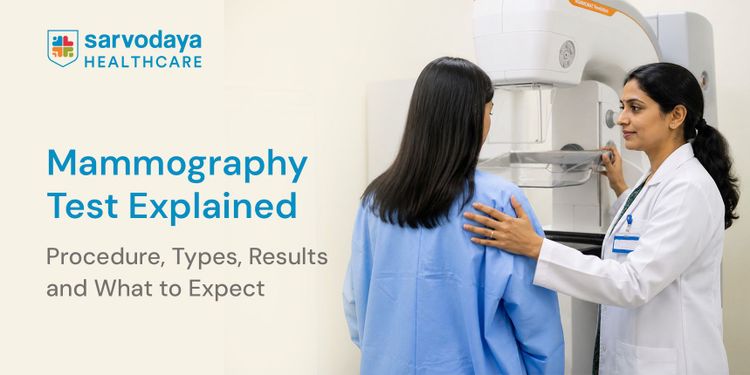


Every woman's general well-being depends on her breast health. One of the most reliable and frequently advised methods for identifying alterations in breast tissue, especially in the early stages of breast cancer, is a mammography test.
In this blog, we explore what a mammogram is, why it is performed, the different mammogram types, and what your mammogram results mean.
Exploring a Mammography Test
The mammography test is a specialised X-ray imaging technique that is used to thoroughly analyse breast tissue. Radiologists can detect anomalies like lumps, calcifications, or other alterations that might point to breast cancer or other benign disorders by using low-dose X-rays to provide clear images of the internal anatomy of the breast.
For women over a specific age or those with elevated risk factors, mammography is frequently advised as the gold standard for breast cancer screening. It is an outpatient, non-invasive technique that usually takes less than half an hour to complete.
Read More- What is Breast Cancer? Symptoms, Causes, Types, Stages & Treatment Explained
Purpose of a Mammogram
Early detection is the main goal of a mammography procedure. Early detection greatly improves the prognosis and makes breast cancer much more treatable.
Mammography serves a range of clinical purposes, and doctors may recommend it for the following reasons:
- Screening: To detect breast cancer in women who have no visible symptoms. Regular screening helps identify cancer before it becomes clinically apparent.
- Diagnostic: To investigate a specific concern, such as a lump, nipple discharge, or breast pain, flagged by the patient or a clinician during a physical examination.
- Monitoring: To track changes in women with a history of breast abnormalities or those who have previously undergone breast surgery.
Mammogram Types
Multiple types of mammography are offered today as a result of advancements in imaging technology, each of which is suited to different therapeutic requirements and patient profiles.
The following are the most commonly used mammogram types:
- 2D Mammography (Digital Mammography): The standard form of breast imaging, producing flat, two-dimensional images of the breast. It is widely available and suitable for most women.
- 3D Mammography (Digital Breast Tomosynthesis): A more advanced technique that captures multiple images from different angles to create a three-dimensional picture of the breast, particularly useful in women with dense breast tissue.
- Contrast-Enhanced Mammography (CEM): Uses a contrast agent to highlight areas of abnormal blood flow, improving the detection of lesions that may be missed by standard imaging.
- MRI-Guided Mammography: Used in high-risk patients or where other imaging has been inconclusive.
Your doctor or breast specialist will recommend the most appropriate type based on your age, risk profile, and breast density.
Read More- A Complete Guide to Breast Cancer Examination, Self-Checks, and Treatment Options
The Mammogram Procedure
Usually, the full mammography process takes 20 to 30 minutes.
Although compression is quick and essential for precise imaging, some women may feel a little uncomfortable. Because breasts are more sensitive the week before your period, it is best to avoid scheduling a mammogram during that time.
The typical steps involved are as follows:
- You will be asked to undress from the waist up and provided with a gown.
- You will stand in front of a specialised imaging unit known as a mammography machine.
- A trained technician will position your breast on a flat support plate, and a compression paddle will gently press the breast flat to spread the tissue for clearer imaging.
- X-ray images are taken from two angles: top-to-bottom and side-to-side.
- The process is then repeated for the other breast.
Understanding Mammogram Results
A radiologist evaluates your mammography data and reports them using the BI-RADS (Breast Imaging Reporting and Data System) classification, which goes from Category 0 to Category 6.
Here is a brief overview of what your mammogram results may indicate:
- Normal (BI-RADS 1 or 2): No significant abnormality detected. Routine screening is recommended at the advised interval.
- Additional Imaging Required (BI-RADS 0 or 3): Further investigation, such as a follow-up scan or ultrasound, is needed to clarify findings.
- Suspicious (BI-RADS 4): Abnormal findings are present that may warrant a biopsy for further evaluation.
- Highly Suggestive of Malignancy (BI-RADS 5): Findings strongly indicate breast cancer, and biopsy is strongly advised.
Cost of a Mammography Test
In India, the mammography price in India varies depending on the type of scan, the technology used, and the medical institution; more advanced choices, like 3D tomosynthesis, may be more expensive. Bundled screening packages are available at several hospitals, especially at the top cancer hospital in Noida, making the test more affordable.
To find out the current cost and whether the test is covered by your health insurance plan, it is advisable to contact your hospital.
Read More- Debunking 10 Myths About Breast Cancer
Conclusion
A mammography test is one of the most important preventive health tools available to women today. Whether you are attending a routine screening or investigating a specific concern, mammography provides clinicians with vital information that shapes the course of care.
At Sarvodaya Hospital, Faridabad, the dedicated oncology and radiology teams provide comprehensive mammography breast cancer screening using advanced imaging technology. Home to the best cancer doctors in Faridabad, Sarvodaya Hospital offers personalised preventive consultations that help identify risk factors early and guide patients towards timely, effective treatment. As the most trusted cancer hospital in India, they ensure that patients receive consistent, world-class care at every stage of their breast health journey.
If you are due for a mammogram or have concerns about your breast health, book an appointment now and take the first confident step towards proactive, informed care.