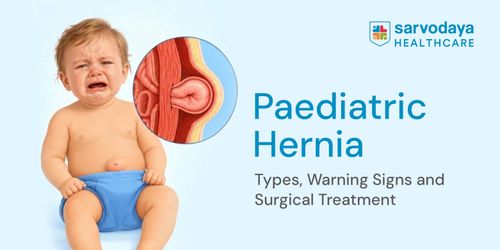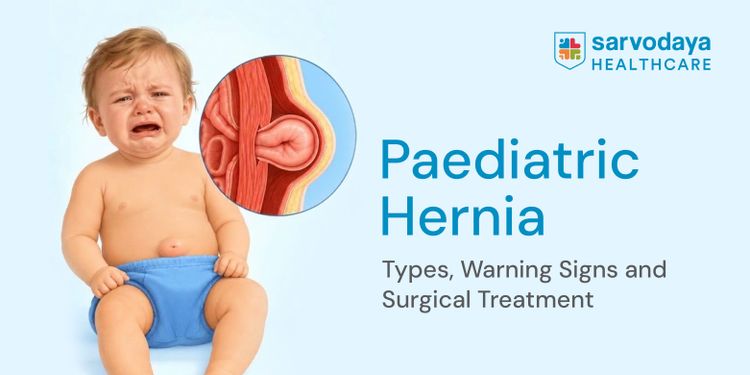


Noticing a lump near your child's belly button or groin may make you worried. The lump might show up when the baby is crying and go away when he or she calms down.
This may be due to a hernia, which is a bulge caused by tissues protruding through a gap in the abdominal wall. Most childhood hernias are asymptomatic, but a few need surgery.
In this blog, we explain the types of hernia in children, their causes and warning signs.
Understanding Hernia in Children
Internal organs are supported by abdominal muscles. A hernia occurs when tissue, usually intestine, extends through an opening in the abdominal wall. This opening is typically present in a baby's body prior to birth.
A paediatric hernia becomes more noticeable when increased pressure is created within the abdomen, such as by crying, coughing or straining. The treatment depends on the location of the swelling.
Common Types of Hernia in Children
Childhood hernias are usually found in the groin area or around the belly button. Both can appear as soft lumps but require different treatment.
The two main types are described below:
- Inguinal Hernia: An inguinal hernia in children develops when a passage between the abdomen and groin remains open. The swelling can spread to a boy's scrotum or a girl's labia. Occasionally, an ovary can enter the opening. These hernias cannot heal on their own.
- Umbilical Hernia: An umbilical hernia in children appears near the belly button when the surrounding muscles have not fully closed. These hernias are usually painless and often close as a child grows. Surgery may be needed if the opening does not close as the child grows or if complications develop.
Recognising Hernia Symptoms in Children
Usually, the first sign is a lump, not pain. The lump may appear when your child cries and becomes less visible during sleep.
Common hernia symptoms in children are:
- A soft swelling around the groin, scrotum or belly button
- A bulge that enlarges when the child cries, coughs or strains
- Child groin swelling that appears and disappears throughout the day
- Umbilical swelling in babies that becomes less noticeable during sleep or rest.
- Discomfort or fussiness when the swollen area is touched
Because babies can't explain their discomfort, baby hernia symptoms may be hard to spot. Parents must also watch for changes in feeding and/or behaviour. If the swelling goes down before the appointment, then a picture may be used to help the surgeon determine the size of the swelling.
Causes and Risk Factors
Inguinal hernias occur when a passage between the abdomen and the groin is not closed at birth. It's more likely to happen in boys and premature babies but can happen in any child.
An umbilical hernia is caused by incomplete closure of the muscles around the umbilical area. Parents do not cause these openings. Crying does not cause a hernia, and placing tape or pressure on the navel cannot correct it.
Diagnosis of Paediatric Hernia
The physician asks when the lump occurs and if there is pain or vomiting. They examine the abdomen and groin, sometimes while the child coughs or cries. A physical examination is often enough to diagnose a hernia.
An ultrasound might be performed if the diagnosis is still not certain. Fluid around a testicle, called a hydrocele, can look like a hernia but may need different treatment. Accurate diagnosis is important for paediatric hernia treatment.
When Hernia Surgery Is Needed
Whether surgery is needed depends on the type of hernia. Inguinal hernias generally require repair, while many umbilical hernias close naturally. The child's age and overall health also influence the timing of surgery.
Surgery for Inguinal Hernia
An inguinal hernia in children is usually repaired promptly, as it won't close by itself. Incarceration can occur when the intestine or an ovary gets stuck in the opening. The surgeon considers the child's age and health when planning surgery, especially for premature babies.
Surgery for Umbilical Hernia
Most cases of umbilical hernia in children are painless and close naturally by the age of four or five. Paediatric surgery may be considered if the hernia persists, causes symptoms or develops complications. Larger openings should be individually evaluated. A hernia can't be closed with coins, tight bands or home remedies.
Warning Signs That Need Emergency Care
Sometimes, the intestine or other tissue becomes trapped in a hernia. If its blood supply is cut off, the tissue can become damaged. This is called strangulation and requires emergency treatment.
If your child experiences any of these symptoms, get emergency treatment:
- A hard, painful bulge that doesn't decrease in size when it is at rest.
- A red, dark or odd colour on the skin above the lump
- Frequent vomiting (particularly vomiting green vomit)
- The abdomen is enlarged, and the child is in pain or will not stop crying.
- Child's poor feeding, unusual sleepiness or the child seems very unwell
Avoid pushing the lump back in place. If a paediatric hernia is trapped, it must be evaluated immediately.
Hernia Surgery and Available Techniques
During hernia surgery in children, the surgeon moves the tissue back into place and closes the opening. General anaesthesia keeps the child asleep and pain-free during surgery. The surgeon chooses the repair method based on the hernia and the child's needs.
These are the typical methods used:
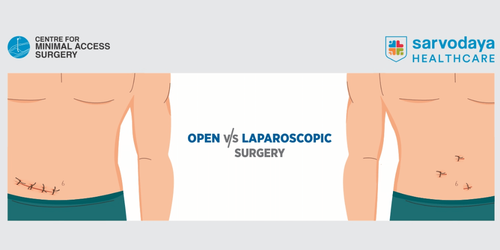
- Open Repair: A small incision is made around the groin or belly button. The surgeon then closes the opening with stitches. Many childhood hernias can be treated this way.
- Laparoscopic Repair: This repair is performed using a camera and instruments that are inserted through small cuts. In selected cases, this may reduce discomfort and allow the surgeon to examine the opposite groin.
The mesh implants used in adults are not typically indicated in children. The top paediatric surgeon in Faridabad can explain the risks and benefits of each technique. Laparoscopy is not necessarily best for every child.
Preparing Your Child for Surgery
Prior to surgery, the team monitors your child's health, medication, allergies and diseases. They will advise you when your child needs to stop eating and drinking before surgery. It is important that your child follows these instructions to ensure their safety.
Ask how long the surgery will last, what pain relief your child will need and if an overnight stay will be required. Doctors may need to provide additional care for premature babies. The anaesthetist will discuss with your child the risks that apply to him/her.
Recovery and Care After Surgery
Most children can go home on the same day after uncomplicated surgery. Mild pain, swelling or bruising may last a few days. Children can gradually return to normal activities, but rough play and sports should wait until the surgeon advises.
The following steps can help your child recover safely at home:
- Give pain relief as advised by the healthcare team
- Keep the wound clean and follow the bathing instructions provided
- Offer food and fluids as your child feels able after anaesthesia
- Avoid strenuous play until the surgeon says it is safe
- Seek medical advice if your child develops increasing redness, fever, wound discharge or worsening pain
Conclusion
It is important for parents to know how to spot hernia in children at an early stage. Most umbilical hernias heal on their own, and inguinal hernias usually require surgical treatment. It is also crucial to know the warning signs because a painful, trapped hernia needs immediate care.
At Sarvodaya Hospital, paediatric surgeons evaluate and treat groin and abdominal wall hernias in children and babies. They use paediatric anaesthesiology and advanced recovery facilities and recommend minimally invasive surgery in appropriate cases. Laparoscopic surgical repairs are typically less painful and lead to faster recovery in some patients, as they are performed with smaller incisions than open surgery.
Speak with Sarvodaya's specialists about diagnosis and paediatric hernia treatment, and book an appointment now to plan the next step for your child's care.