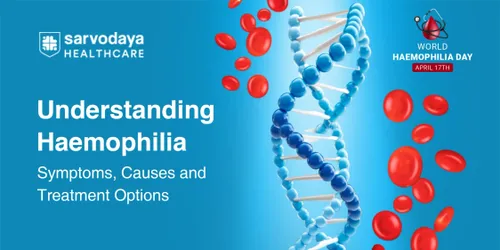

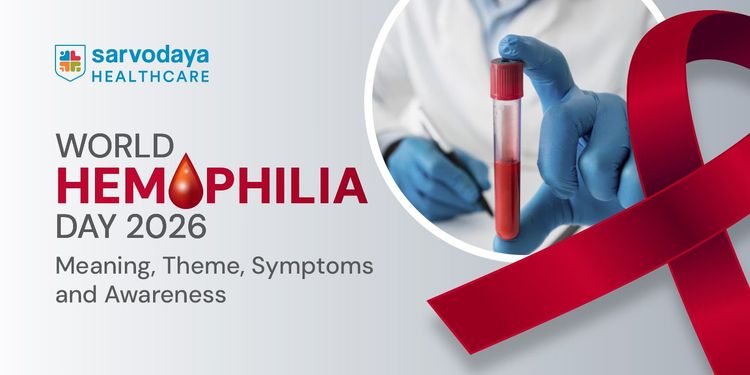


As per the World Federation of Haemophilia (WFH), 75% of people suffer from a severe bleeding disorder, Haemophilia, without even knowing it, simply because they don’t have access to basic healthcare. By globally celebrating World Haemophilia Day 2026 (April 17) with a theme “Diagnosis: First step to care,” everyone receives basic medical facilities and gets timely treatment.
Beyond the theme, World Haemophilia Day carries a history. It marks the birthday of Frank Schnabel, founder of the World Federation of Haemophilia.
The World Haemophilia Day theme 2026, “Diagnosis: First step to care,” draws attention to the significance of diagnosis as the most critical step towards treating haemophilia.
In this blog, we will explore the significance of World Haemophilia Day and how the day can be beneficial to you. Moreover, if you are suffering from the disorder, you will receive an in-depth analysis of the signs, causes, types, best treatments for haemophilia, and the best doctors available in your locality.
What is Haemophilia?
Haemophilia is a rare bleeding disorder where an individual can bleed for days from a minor cut or injury. The bleeding can be external, like cuts, or internal, like bleeding into joints or muscles.
Why is bleeding time prolonged in haemophilia?
When a person bleeds, tiny blood cells (called platelets) rush to the injury site and form a solid clot. But in conditions like haemophilia, the blood lacks sufficient clotting factors, which are proteins essential for stopping bleeding.
Here, clotting refers to the process of turning liquid blood into a solid clot, and factors are the specific components needed to make the clot. When clotting factors don’t work properly, the clot doesn’t form, and the bleeding time extends.
What is World Haemophilia Day?
World Haemophilia Day, observed every year on April 17, is a global haemophilia awareness initiative that promotes the first and most essential step: Diagnosis.
With 75% undiagnosed individuals who are suffering from bleeding disorders, the day is comparatively more important than general health days.
The date, World Haemophilia Day, April 17, also marks the birth anniversary of Frank Schnabel, founder of the World Federation of Haemophilia.
Why World Haemophilia Day matters?
- Encourages early recognition of bleeding symptoms
- Promotes access to diagnostic testing
- Supports long-term management awareness
- Connects patients to specialised care centres
The main reason for a large percentage still unknown to their disorder is a lack of accessibility to basic healthcare facilities. Haemophilia Day ensures that individuals and healthcare facilities are on the same page.
World Haemophilia Day 2026 Theme
The World Haemophilia Day theme 2026, “Diagnosis: First Step to Care,” highlights a fundamental gap in current healthcare systems: The diagnosis.
What World Haemophilia Day theme mean in practice?
- Identifying mild or overlooked cases
- Reducing delays in clinical evaluation
- Improving access to factor testing
- Enabling preventive (prophylactic) care
For patients and families, this day is very important. It encourages early diagnosis and effective treatment.
Importance of World Haemophilia Day
The importance of Haemophilia awareness day is not limited to awareness. It can encourage patients to seek haematology doctors early, especially when a large number of individuals remain undiagnosed despite medical advancements.
This delay often leads to avoidable joint damage, repeated bleeding episodes, and reduced quality of life.
Why is World Haemophilia Day important?
- Builds haemophilia awareness among patients and primary care providers
- Reduces the wrong diagnosis of unexplained bleeding
- Encourages screenings and tests if any symptoms are detected
- Supports policy-level improvements in rare disease care
Most importantly, for people suffering from internal bleeding, it reduces the risk of joint damage and repeated bleeding episodes, improving quality of life.
Types of Haemophilia
There are three main types of haemophilia, each defined by which clotting factor is missing. To understand the type of haemophilia, you need to understand what “clotting factors” mean.
What are blood-clotting factors?
We have more than 10 blood clotting factors, each playing its specific role in the clot formation process. So, when a doctor says that Factor VIII is missing, it means that the protein that forms blood clots is not present.
While these define the types of haemophilia, severity varies across all forms based on clotting factor activity levels.
The three types include:
- Haemophilia A (Factor 8 deficiency): Nearly 80% of cases are affected by this type, mostly men. It happens when Factor 8 is missing-a protein that forms blood clots.
- Haemophilia B (Factor 9 deficiency): Less common and can be seen in 20% of cases. Again, it happens predominantly in males due to a deficiency of Factor 9, a protein that controls bleeding.
- Haemophilia C (Factor XI deficiency): A rare and least common type. It happens when a specific protein that helps make blood clots is missing.
The difference among haemophilia A, B, and C is that type A and B happen when the gene is inherited from one of the biological parents, while Type C is when faulty genes are inherited from both parents.
What Causes Haemophilia?
Haemophilia A and Haemophilia B are caused when an error occurs in a specific gene on the X chromosome, leading to low or missing clotting factors.
Broadly, haemophilia can develop in two ways: congenital (inherited) and acquired (not inherited).
- Congenital Haemophilia: When a person is born with the condition, meaning it is inherited.
- Acquired Haemophilia: It occurs when the immune system attacks clotting factors, often linked to autoimmune conditions, cancer, or pregnancy.
Consulting a top blood specialist in Delhi NCR can help in accurately diagnosing your condition.
How Are Haemophilia Genes Inherited?
To understand what causes haemophilia, it is important to look at how chromosomes are inherited from parents to children. Females have two X chromosomes (XX), while males have one X and one Y chromosome (XY). The genes responsible for clotting factors 8 and 9 are located on the X chromosome.
This means the presence or absence of a healthy X chromosome decides the presence of haemophilia.
Why is Haemophilia More Common in Males?
A male child inherits his X chromosome from his mother and a Y chromosome from his father. If the X chromosome carries the faulty gene, he has no second X chromosome.
As a result, he develops haemophilia.
In contrast, females have two X chromosomes.
If one X is faulty, the cells will use the other healthy X. This gives her enough clotting factor to be totally fine.
However, in rare cases, females can develop haemophilia if both X chromosomes are affected.
Diagnosis of Haemophilia
The diagnosis always starts with a consultation from the best haematologist in Delhi NCR. The doctor will ask about your medical history, current condition, and if anyone in the family has the disorder.
- Complete Blood Count (CBC): To analyse and measure your blood cells.
- Prothrombin Time (PT): Measures how quickly blood clots.
- Activated Partial Thromboplastin Time (aPTT): A critical test that measures clotting time.
When it comes to diagnosis, it becomes crucial that you seek treatment from the best hospital for Hemophilia in Delhi NCR.
Treatment Options for Haemophilia
There is no complete cure for haemophilia A or haemophilia B, but treatment today is highly effective.
With the right haemophilia treatment, most patients can live active, near-normal lives.
Current treatment options include:
- Replacement therapy: The missing clotting factor is given through intravenous (IV) injections, going directly into a vein. Preventive (prophylactic) therapy is the most common way that replacement therapy is used.
- Non-factor therapies: These treatments improve clotting without replacing the missing factor. In such therapies, Emicizumab (modern, lab-made protein) is widely used, which mimics what that factor does without actually being it.
- Gene therapy: Aims to help the body produce its own clotting factor by correcting the faulty gene. Its availability is rare in India. However, some of the best hospitals for Haemophilia in Delhi NCR offer it.
- Physiotherapy and joint care: Even if the bleeding stops, regular exercise and joint protection are essential to prevent long-term damage from repeated bleeding.
Consulting a top blood specialist in Delhi NCR can help in accurately diagnosing your condition.
Haemophilia Care at Sarvodaya: Diagnosis, Treatment and Long-Term Support
If you are searching for “Haemophilia treatment centre near me,” the treatment at Sarvodaya Hospital not only focuses on accurately diagnosing the disorder, but also provides personalised treatment options.
What will you find at Sarvodaya?
- Expertise in bleeding disorders, haematological diseases, and bone marrow transplantation
- Comprehensive diagnostics, including factor assays, coagulation testing, and genetic evaluation
- Treatment pathways covering factor replacement and newer non-factor therapies
- Structured prophylaxis plans to prevent bleeding and protect joint health
- Advanced therapies like gene therapy, replacement therapy, and non-factor therapies
- Integrated physiotherapy support for mobility and long-term joint care
- Coordinated multidisciplinary care across haematology, oncology, and supportive teams
- Accessible centres in Faridabad and Noida for families across Delhi NCR
If you are noticing signs of abnormal bleeding, consulting the best haematologist in Greater Noida can make a meaningful difference.
You can connect with the haematology team at Sarvodaya Hospital for further guidance and care.
Others Awarness Days: