


Our heart and lungs play a vital role in supplying oxygen to the body. Deoxygenated blood (blood rich in carbon dioxide) flows from the heart to the lungs, where carbon dioxide is removed, and oxygen is added. The oxygen-rich blood then returns to the heart, which pumps it throughout the body to supply all organs, tissues, and muscles.
However, in critical conditions, there are moments when the heart or lungs are so severely affected and damaged that they are not able to perform this major function.
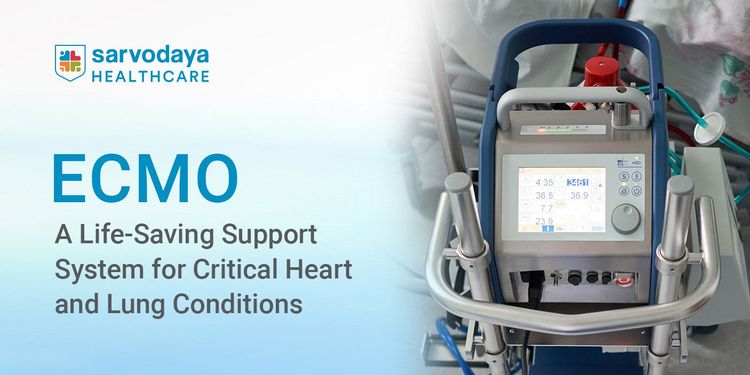
When conventional treatments are no longer enough, doctors at the best critical care hospital in Faridabad may turn to a highly advanced life-support technology called ECMO (Extra-Corporeal Membrane Oxygenation). It is an artificial life support that continuously pumps blood out of your body and pumps it back in after externally removing carbon dioxide and adding oxygen to it.
Sarvodaya Hospital, Sec 8, Faridabad, is the only hospital in the area where the best critical care doctors use this highly advanced technology and technique for critical patients, giving them another chance at life in life-threatening situations when lungs or heart can’t function properly.
It is a life support just like another life support ventilator. While a ventilator can only move air, ECMO, on the other hand, functions like an artificial heart and lungs, which can exchange gases and pump blood in the body.
Coming across the process for the first time might feel overwhelming. In this blog, we have simplified and explained ECMO, the process, the benefits, and all other related aspects.
Understanding ECMO in Simple Terms
To begin with, the full form and meaning of ECMO is Extracorporeal Membrane Oxygenation. It is an advanced machine that temporarily performs the function of the heart and/or lungs when they are unable to work properly on their own.
If you are wondering what ECMO treatment is, consider that it is essentially an advanced form of life support in which blood is taken out of the body, purified and oxygenated through a machine, and then returned. This allows the heart and lungs to rest and recover while doctors focus on treating the underlying cause of illness.
Read More-
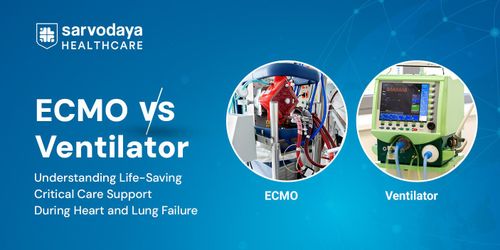
ECMO vs Ventilator: Understanding Life-Saving Critical Care Support During Heart and Lung Failure
Types of ECMO and How They are Used
The highly advanced life support machine ECMO is broadly classified by where the blood is taken from and returned to, and which organs need support.
1. Veno-Venous (VV ECMO)Supports: Lungs when the heart is still pumping blood naturally.
When it’s used:
- Severe lung failure (e.g., ARDS, pneumonia)
- When the heart is functioning well
How it works:
- Blood is taken from a vein
- Oxygenated in the machine
- Returned to a vein
- When oxygen-rich blood is returned to a vein, the body completes the rest of the circulation naturally, where the blood enters the right side of the heart, is taken to lungs even though the blood is oxygenated by ECMO, and then from lungs the blood flows back to the left side of the heart from where the artery carries it to the whole body naturally.
Supports: Heart and lungs - both circulation and oxygenation
When it’s used:
- Heart failure
- Cardiac arrest
How it works:
- Blood is taken from a vein
- Oxygenated in the machine
- Returned into an artery
- After the oxygen-rich blood is returned to an artery, the machine directly supports circulation, bypassing much of the heart’s workload.
Supports: Heart + lungs (with flexible support)
When it’s used:
- When both heart and lung support are needed, but in varying degrees
- Complex ICU cases
How it works:
- Blood is drained from a vein
- Returned to both a vein and an artery
- When blood is returned to both a vein and an artery, the support is split between lung function and circulation, allowing doctors to adjust how much help each organ gets. The process continues as it does when the blood is returned to the arteries or veins in other systems.
VAV ECMO creates a balanced, adjustable system where doctors can:
- Increase arterial flow → more heart support
- Increase venous return → more lung-focused support
ECMO Procedure
A common concern is understanding how ECMO works for patients. The process involves placing tubes (called cannulas) into large blood vessels.
- Blood flows out of the body into the ECMO machine through a tube in a large blood vessel in the chest, neck or legs.
- Carbon dioxide is removed, and oxygen is added to the blood
- The oxygen-rich blood is then pumped back into the body through an artery or a vein, and sometimes both, depending on the machine and the patient’s requirement
This continuous circulation ensures that the vital organs, such as the brain, kidneys, and liver, receive the oxygen they need to function. Without this support, severe heart or lung failure can quickly become life-threatening.
Throughout the process, the dedicated delhi critical care specialist routinely keep a check on the heart and lung functions.
An ECMO specialist will routinely check your heart and lung functions while you’re on ECMO to make sure you’re in good condition and there are no complications. This also lets providers know how much longer to keep you on ECMO and to decide the duration of the procedure.
Conditions and Situations Where ECMO May Be Needed
Doctors consider ECMO only in serious and carefully selected cases. Typically, when ECMO becomes relevant, it is when all standard treatments, such as ventilators, medications, or less invasive interventions, have not been effective. It may be used for:
- Severe Lung Conditions (Respiratory Failure) - Usually VV ECMO
- Acute Respiratory Distress Syndrome (ARDS)
- Severe pneumonia or lung infections
- COVID-19 complications
- Aspiration (food/liquid entering lungs)
- Lung injury due to trauma or inhalation (smoke, toxic gases)
- Severe Heart Conditions (Cardiac Failure) - (Usually VA ECMO)
- Heart attack (Myocardial Infarction)
- Cardiogenic Shock
- Severe heart muscle weakness (Cardiomyopathy)
- Cardiac arrest (when the heart stops beating effectively)
- Myocarditis (inflammation of the heart)
- Combined Heart and Lung Failure - VA or VAV ECMO
- Severe sepsis affecting both the heart and lungs
- Advanced respiratory failure with heart strain
- Massive pulmonary embolism (blood clot in lungs)
- During or After Major Surgeries
- Complex heart surgeries
- Lung transplant or heart transplant
- Post-surgery complications where recovery needs temporary support
- In Newborns and Children
- Meconium aspiration (baby inhales stool during birth)
- Congenital heart defects
- Severe lung immaturity in premature babies
- Bridge Therapy (Temporary Support)
- Waiting for a heart or lung transplant
- Allowing time for recovery in reversible conditions
What Families Should Know About ECMO Care
Doctors at the top critical care hospital in Faridabad explain ECMO treatment to families in detail and keep them updated about the patient’s health progress.
Patients on ECMO are usually in the Intensive Care Unit (ICU), surrounded by monitoring equipment. They may be sedated, and multiple tubes and machines will be visible.
Being informed and emotionally prepared can help families navigate this difficult phase with more clarity and confidence. The experienced critical care team and staff offer constant support to the families during the challenging time.
Benefits of ECMO
ECMO is a critical life-support intervention used when conventional treatments are not sufficient to maintain proper heart and lung function. Its benefits are centred around buying time and protecting organs. Some of the common benefits include:
- Provides life-saving blood oxygenation
- Supports heart function by maintaining blood circulation to vital organs.
- Allows the lungs and heart to rest and recover by reducing stress
- Improves chances of recovery by giving conditions to respond to treatment
- Acts as a bridge therapy during transplant and evaluation of further treatment options
- Reduces the risk of ventilator-induced lung injury by minimising pressure on already damaged lungs.
- Ensures continuous blood flow to the brain, kidneys, and other vital organs, reducing the risk of multi-organ failure.
Survival and Outcomes
ECMO survival rate, which is a valid concern as the outcomes can vary significantly depending on factors such as the patient’s age, underlying condition, and how early ECMO is initiated.
Patients with reversible lung conditions tend to have better outcomes. On the other hand, cases involving multiple organ failure or severe underlying disease may have lower survival rates. Despite this, ECMO has been shown to improve survival chances in situations where other treatments have failed.
Conclusion
While it is not easy to see a loved one go through such hard times, ECMO proves to be a life-saving boon for heart and lung failure patients when other treatments don’t work. At Sarvodaya Hospital, Sector 8, Faridabad, we have highly experienced teams of critical care experts who offer 24x7 care to patients with the best modalities and technologies.
Our care extends to families, and we provide them with every necessary information and Clinical psychological support to help them deal with the situation.
After the procedures and treatment, we offer advanced physiotherapy and rehabilitation to help the patient get back on their feet and live a normal life. Consult with the experts at the hospital at 18003131414 to understand the treatment better and get answers to all your queries.