


When a loved one is admitted to the ICU with severe breathing or heart problems, terms like ventilator and ECMO can feel overwhelming. Both are advanced life-support systems used in critical care, but they serve different purposes and are used at different stages of illness.
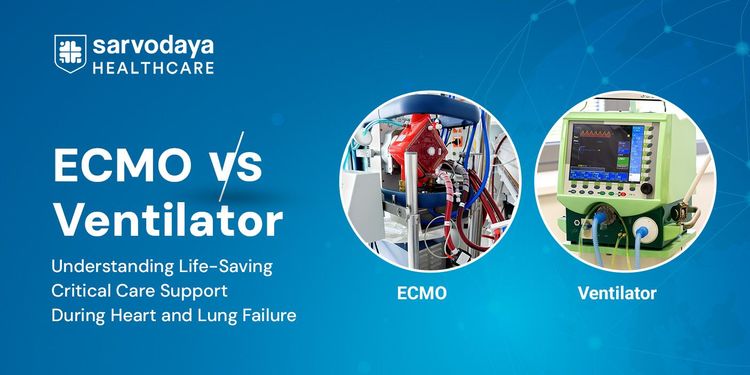
While ventilators help the person breathe, ECMO works in place of the heart and lungs by oxygenating blood and ensuring it flows to all vital organs in the body.
The following blog explains how ECMO is different from a ventilator, its key differences and what to expect during both processes.
What is a Ventilator and Mechanical Ventilation?
Mechanical Ventilation is a form of life support that helps a patient breathe (ventilate) when they can’t breathe on their own. This can be during surgery, a critical situation or a major illness.
It only helps in stabilising the patient during their treatment and recovery and does not directly treat any condition.
Whereas, a ventilator is a machine that supports mechanical ventilation and helps a person breathe when they are unable to do that on their own. It supports the lungs by providing oxygen, helping remove carbon dioxide and providing pressure to keep small air sacs in the lungs from collapsing.
How it works:
- A tube is inserted into the airway (intubation)
- The machine pushes oxygen-rich air into the lungs
- It also helps remove carbon dioxide from the body
The ventilator supports the lungs, but it still depends on the lungs to function to some extent for oxygen exchange.
Note: The lungs play a vital role in keeping the body functioning by supplying oxygen to the blood and removing carbon dioxide, a waste gas. They enable efficient gas exchange, helping maintain the body’s acid–base balance.
Types of Mechanical Ventilation
There are two types of mechanical ventilation:
- Invasive Mechanical Ventilation, in which a tube is inserted into the patient's airway through the mouth or neck, which is connected to a ventilator
- Non-invasive Ventilation, in which a face mask, strapped around the patient's head, is connected to a ventilator. There is no requirement to insert any tube. Air is pushed into the lungs through the external mask.
When is a ventilator used?
A ventilator is commonly used in:
- Severe pneumonia
- Acute Respiratory Distress Syndrome (ARDS)
- COVID-19 complications
- Major surgeries (short-term support)
- Trauma or unconscious states
In most ICU settings, the ventilator is the first line of advanced respiratory support.
What is ECMO?
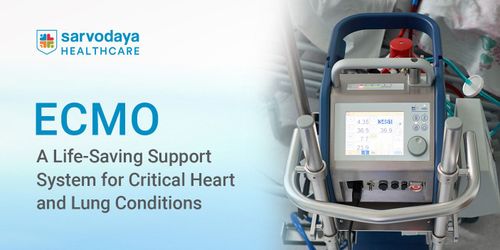
ECMO (Extracorporeal Membrane Oxygenation) is a highly advanced life-support system used when the lungs or heart are severely failing and cannot support life, even with a ventilator.
How ECMO works:
- Blood is taken out of the body through tubes (cannulas)
- It passes through an artificial lung (oxygenator)
- Oxygen is added, and carbon dioxide is removed
- The oxygenated blood is returned to the body
In simple terms, ECMO temporarily replaces the function of the lungs-and sometimes the heart.
Types of ECMO
There are three main types of ECMO (Extracorporeal Membrane Oxygenation), classified based on the kind of support they provide:
- Veno-Venous (VV ECMO): It supports the lungs in cases of severe lung failure. During this, the heart function stays normal.
- Veno-Arterial (VA ECMO): It supports both heart and lungs in cases of heart failure and cardiac arrest. It provides full circulatory support to the body.
- Veno-Arterial-Venous (VAV ECMO): It supports both heart and lungs and is used in complex cases where support is required for both cardiac and respiratory functions in varying degrees.
When is ECMO used?
ECMO is considered in critical situations such as:
- Severe lung failure not responding to the ventilator
- Cardiac failure (heart not pumping effectively)
- Cardiac arrest
- Severe infections (sepsis)
- Bridge to heart or lung transplant
It is typically used only when all conventional treatments fail, including maximum ventilator support.
How do ECMO and Ventilator Work Together?
ECMO and a ventilator are often used together, not as alternatives, in many critical cases. When a patient is put on ECMO, they are usually still kept on a ventilator, but with a different purpose:
1) ECMO takes over the heavy work
- Oxygenates blood and removes carbon dioxide
- Reduces the load on severely damaged lungs (e.g., in Acute Respiratory Distress Syndrome)
2) Ventilator gives “lung rest”
- Runs on low, gentle settings
- Prevents lung collapse
- Allows healing instead of forcing the lungs to work hard
Even though ECMO can oxygenate blood, one must not be taken off of ventilator support because lungs need to stay active and completely stopping ventilation can make the lungs collapse. The ventilator helps in maintaining basic lung structure and function.
What Conditions Require Ventilator vs ECMO?
Ventilator Indications:- Breathing difficulty, but lungs are still functioning partially
- Oxygen levels low but manageable
- Reversible lung conditions
- Oxygen levels are dangerously low despite a ventilator
- Severe ARDS
- Cardiac failure or shock
- Failure of all standard ICU treatments
Risks and Considerations
Ventilator Risks:- Lung injury due to pressure
- Infections (ventilator-associated pneumonia)
- Muscle weakness
- Bleeding (due to blood thinners)
- Infection
- Stroke
- Organ complications
ECMO vs Ventilator: Which is Better?
This is a common question, but clinically, it is not about “better.” It depends on the patient’s condition.
In most scenarios of lung damage, a ventilator is sufficient for many patients. ECMO is used when a ventilator is not enough. It is not a replacement for a ventilator, and only an advanced escalation of the treatment.
Role of Advanced Critical Care
Sarvoaya’s critical care centre brings the top experts in Delhi NCR who provide 24x7 critical care and support. Equipped with all modern modalities, the centre is capable of handling all cases with prompt action and care. We bring a multidisciplinary team of experts with highly experienced pulmonologists, intensivists, cardiologists, critical care specialist and more senior doctors from all super specialities.
The Critical Care Department is equipped to manage the most complex ICU cases with:
- Advanced ventilator support systems
- ECMO (Extracorporeal Membrane Oxygenation) services
- Dedicated ICU specialists and ECMO-trained teams
- Multidisciplinary approach
- 24x7 emergency and critical care support
With a focus on timely intervention, patient safety, and compassionate care, we ensure that patients receive the highest level of support during life-threatening conditions.
Summary for ECMO vs Ventilator
- A ventilator is a machine that supports breathing
- ECMO replaces lung/heart function
- ECMO is used only in severe, life-threatening cases when ventilator support is not enough
- Both are often used together in critical ICU care
- Duration varies from days to weeks, depending on recovery
- Both are safe and do not cause any major trauma to the patient