
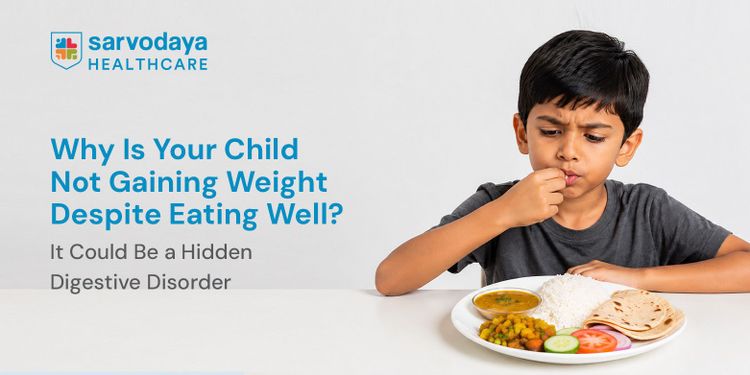


You watch your child eat well, finish meals and enjoy snacks, yet the weighing scale barely seems to move.
It can leave parents wondering: “If my child is eating properly, why isn't the weight increasing?”
Sometimes, the explanation is simple. A child may not actually be getting enough calories or may simply have a naturally smaller build.
But sometimes, the problem is not how much food your child eats. It is how well the body digests and absorbs the nutrients from that food.
Digestive conditions such as celiac disease, inflammatory bowel disease and other disorders that affect nutrient absorption can interfere with a child's ability to gain weight and grow as expected.
So, when should parents consider that poor weight gain may need more than just “eat a little more”?
What Does It Mean If a Child Is Not Gaining Weight as Expected?
Children do not all gain weight at the same speed.
Some children are naturally leaner than their peers and remain healthy. What doctors look for is whether a child's weight and height are following an expected growth pattern over time.
This is why one low reading on the weighing scale does not tell the whole story.
During a routine check-up, a paediatrician may plot your child's weight and height on a growth chart and compare the pattern over time. If growth is consistently slower than expected, doctors may describe it as growth faltering.
But what if my child eats well?
That is an important clue, but it does not rule out a medical problem.
Your child needs to do more than simply eat food. The digestive system has to break that food down, absorb its nutrients and make them available for growth.
If something interferes with this process, a child may continue eating but still struggle to gain weight.
Could a Digestive Problem Stop Your Child From Gaining Weight?
Yes.
Think of food as a package carrying energy, protein, vitamins and minerals.
Your child's digestive system has to open that package and move those nutrients into the bloodstream so the body can use them.
If the intestine is damaged or another digestive condition interferes with absorption, some of those nutrients may pass through the body without being absorbed properly.
So the problem may not be “My child isn't eating enough.” It may be “My child's body isn't getting enough from what they eat.”
This is called malabsorption.
What Digestive Disorders Can Cause Poor Weight Gain in Children?
Several conditions can interfere with digestion or nutrient absorption.
Some include:
- Celiac disease: Gluten triggers an immune reaction that damages the small intestine and can interfere with nutrient absorption.
- Inflammatory bowel disease: Conditions such as Crohn's disease can affect the digestive tract and contribute to poor growth.
- Cystic fibrosis: Digestive problems associated with the condition can make it difficult to absorb nutrients properly.
- Other intestinal or digestive disorders: Problems affecting the structure or function of the digestive tract can also interfere with growth.
This does not mean that every child with poor weight gain has a digestive disorder.
But when poor growth occurs alongside digestive symptoms, doctors may investigate whether the two are connected.
Could Celiac Disease Be the Reason Your Child Isn't Gaining Weight?
Celiac disease is one important digestive condition doctors may consider when a child has difficulty gaining weight or growing as expected.
It happens when the immune system reacts to gluten, a protein found in wheat, barley and rye. This reaction can damage the lining of the small intestine.
Why does that matter for growth?
The small intestine contains tiny structures called villi that help absorb nutrients from food. When celiac disease damages them, the intestine may not absorb nutrients properly.
That means a child can eat a reasonable amount of food but still struggle to get the nutrients needed for healthy growth.
What signs might point towards celiac disease?
The symptoms can vary from child to child.
Parents may notice:
- Chronic diarrhoea
- Bloating or a swollen abdomen
- Excessive gas
- Constipation
- Nausea or vomiting
- Pale or foul-smelling stools
- Poor weight gain
- Shorter-than-expected height or slowing growth
- Anaemia or unusual tiredness
Some children may not have obvious digestive symptoms at all. Difficulty achieving expected weight or height can itself be a reason for doctors to consider celiac disease.
What Other Signs Should Parents Watch For?
Poor weight gain becomes more important to investigate when it appears alongside other changes.
Look out for:
- Weight that remains unchanged or increases very slowly
- Height growth that also slows down
- Persistent diarrhoea or unusually bulky, greasy or foul-smelling stools
- Repeated vomiting
- Frequent abdominal pain or bloating
- Poor appetite or difficulty eating
- Unusual tiredness or irritability
- Signs that your child is not developing or becoming as active as expected
Not every symptom points towards a digestive disorder. Some children may have growth faltering without obvious symptoms, which is why regular paediatric check-ups remain important.
How Does a Doctor Find Out Why a Child Is Not Gaining Weight?
The first step usually isn't a complicated scan.
A paediatrician will start by understanding how your child has been growing over time.
They may look at:
- Previous weight and height measurements
- Growth-chart patterns
- Your child's usual diet and eating habits
- Bowel movements and digestive symptoms
- Medical and family history
- Physical signs such as muscle mass, body fat and general development
If the history and examination suggest an underlying problem, the doctor may recommend tests.
Depending on the suspected cause, these may include blood tests, urine tests, stool tests or condition-specific tests.
For example, if celiac disease is suspected, doctors may use blood tests and, when needed, further evaluation to confirm the diagnosis.
Do not start a gluten-free diet on your own before celiac testing. Removing or reducing gluten beforehand can affect test results.
Does Every Child With Poor Weight Gain Need Treatment?
Not necessarily.
Some children simply need nutritional adjustments and regular monitoring.
If doctors identify an underlying condition, treatment focuses on that specific cause.
For example, a child with a digestive disorder may need a condition-specific treatment plan along with nutritional support. A paediatrician may also involve a dietitian to make sure the child receives enough calories and nutrients for healthy growth.
The important part is to find out why the weight gain has slowed down rather than simply adding more food to every meal.
When Should You Talk to a Paediatrician About Your Child's Weight?
Consider discussing your child's growth with a paediatrician if:
- Your child consistently fails to gain weight as expected.
- Height growth also appears to be slowing.
- Your child has persistent diarrhoea, vomiting or abdominal pain.
- Stools are unusually bulky, greasy or foul-smelling.
- Your child seems unusually tired or irritable.
- You feel that something has changed in your child's eating, digestion or development.
A single measurement does not diagnose a problem. The growth pattern over time gives doctors much more useful information.
How Can Sarvodaya Hospital Help a Child Who Is Not Gaining Weight?
When a child is not gaining weight as expected, simply adding more food to the plate may not solve the problem. The reason could be nutritional, digestive or related to another underlying condition.
At Sarvodaya Hospital, the Centre for Dietetics & Nutrition provides personalised nutrition support for children and adolescents, including:
- Paediatric and adolescent nutrition plans based on the child's age, growth and nutritional needs
- Nutritional assessment and support for malnutrition and weight-related concerns
- Dietary management for digestive disorders, food allergies and food intolerances
- Customised diet plans designed around the child's health condition and everyday eating pattern
- Nutrition support alongside medical treatment when an underlying illness affects growth or nutrient intake
The hospital also has a dedicated Paediatric Gastroenterology department, which provides nutritional assessment and therapy for children with growth concerns, malabsorption and chronic digestive conditions.
The goal is not simply to make a child gain weight. It is to understand why healthy growth is not happening and give the child the right nutritional and medical support.